The first year of your baby’s life often feels like one big nap attempt.
Trying to figure out when your child should be sleeping and for how long can seem like a complicated math equation, leaving parents frustrated and confused. At about four months, your child’s sleep cycle will start to develop, and you will (hopefully) start to see some patterns emerge in their sleeping habits. This is when you can really start to think about implementing a loose sleep schedule that helps keep the household running smoothly.
But even though you may set an “ideal” schedule for your baby’s sleep, it is often challenging to stick to a consistent schedule each day since there are so many factors that play into when your child sleeps. And it is completely normal for your baby’s sleep to vary in the first year of life. This is why it is important to follow both a loose schedule and awake windows, adjusting as needed. And while you shouldn’t set a schedule prior to four months, the great news is that you can follow awake windows at any age.
What are awake windows?
Awake windows are just as they sound: the time your baby is awake between each nap and nighttime sleep. Each child, based on their age, has a threshold of time that they are able to stay awake depending on where they are in their development.
The reason we talk about awake windows so much in the sleep world is because of the impact it has on your child’s ability to fall and stay asleep. If you put a child down for nap or bedtime past their threshold, you run the risk of having an overtired baby, which leads to a slew of other issues. Likewise, if you put your baby down too early, she may have trouble falling asleep if there hasn’t been enough sleep pressure built up.
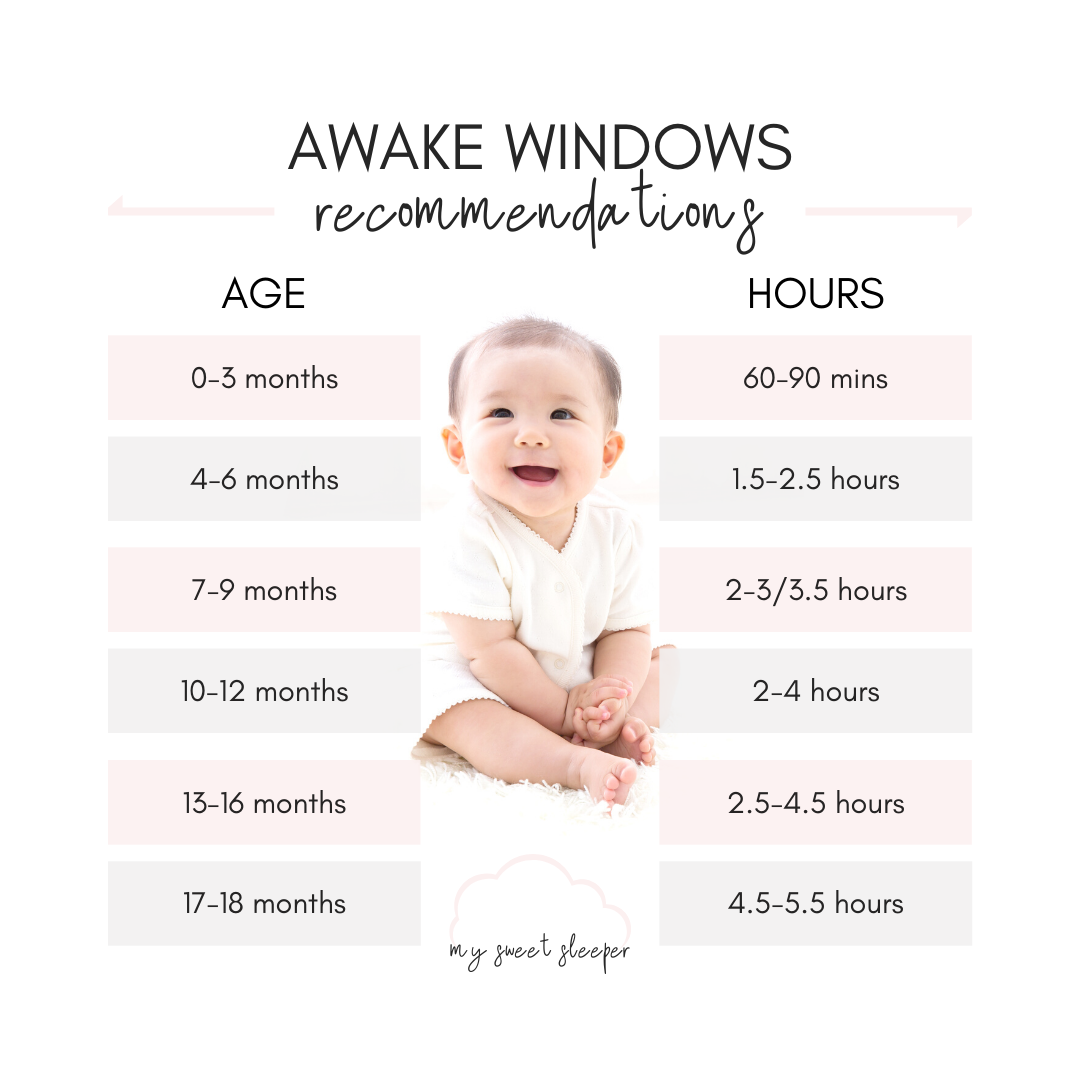
Here are our recommended awake windows by age:
0-3 months- 60-90 minutes
4-6 months- 1.5-2.5 hours
7-9 months- 2-3/3.5 hours
10-12 months- 2-4 hours (morning can still be short)
13-14 months- 2.5-4.5 hours
15-18 months- 4.5-5.5 hours (try to follow a schedule at this age)
Keep in mind that these might vary depending on how long naps your baby is taking and how rested they are from night sleep.

How to adjust awake windows
As I mentioned above, following awake windows is just part of the equation. If your baby is four months or older, you still want to have a schedule that you are keeping in mind, which will likely be adjusted slightly day to day. Based on nighttime sleep and the length of naps, you’ll want to adjust awake windows, which will then shift your child’s schedule.
For example:
If you’re following a 7am-7pm schedule with your five-month-old, your child will likely wake for the day around 7am, and the first nap will be close to 9am. If she sleeps a solid nap (which I consider one hour or more minimum), you can plan on putting her down for her next nap about two hours after she wakes from her morning nap, so in this case, 12 pm.
However, if your child only sleeps 30-45 minutes (only one sleep cycle), you’ll want to shorten that sleep window a bit, by thirty minutes, so you don’t have an over-tired baby on your hands. The key to shifting awake windows is to follow a pattern based on your child’s unique patterns and sleepy cues. It can feel a bit confusing to navigate at first, but once you start to follow a loose schedule, your baby’s cues, and awake windows, it will start to feel more natural.
It is also important to remember that your baby’s sleeping patterns are constantly changing within the first year, so try to give yourself some grace if you sometimes miss the optimal window, or heaven forbid you miss a nap! Remember that even slow progress is progress, and consistency is key. Trying to change your child’s schedule too often for fear that it isn’t working is only going to make it more challenging for your child (and you).
If it becomes frustrating or overwhelming, you can always reach out for help. Our goal is to support you and guide you along this beautiful journey. Feel free to contact us for guidance or try our nap training guide that will walk you through the exact process of shifting your child’s naps! You may also want to look into our newborn sleep course or 4-12 month sleep course.
FAQs
1. What exactly counts as an "awake window"?
An awake window is simply the stretch of time your baby is awake between sleep periods, whether that's between two naps or between the last nap and bedtime. Every little one has a different threshold for how long they can comfortably stay awake, and that threshold shifts as they grow.
2. My baby is younger than four months. Should I still be watching awake windows?
Yes! While we recommend holding off on a structured sleep schedule until around four months, awake windows are useful at any age. Following them from the start can help you avoid an overtired baby and set the stage for smoother sleep once you're ready to introduce a schedule.
3. What happens if I miss the awake window and my baby gets overtired?
It happens to every parent, so try not to be too hard on yourself. An overtired baby may have a harder time falling or staying asleep, but one missed window won't undo your progress. Just aim to get back on track with the next nap or bedtime, and remember that consistency over time matters more than any single day.
4. How do I know if I should shorten or lengthen my baby's awake window?
It comes down to how well they slept beforehand. If your little one takes a solid nap (an hour or more), you can generally stick with the fuller end of their awake window range. If they only catch a short nap of 30 to 45 minutes, it's often best to shorten the next window by about 30 minutes so you don't run into overtiredness.
5. My baby's sleep patterns keep changing. Is that normal?
Completely normal. Sleep patterns shift constantly throughout the first year, so awake windows and schedules need to flex right along with them. Give yourself grace, watch your baby's cues, and know that even slow, steady adjustments are still progress.